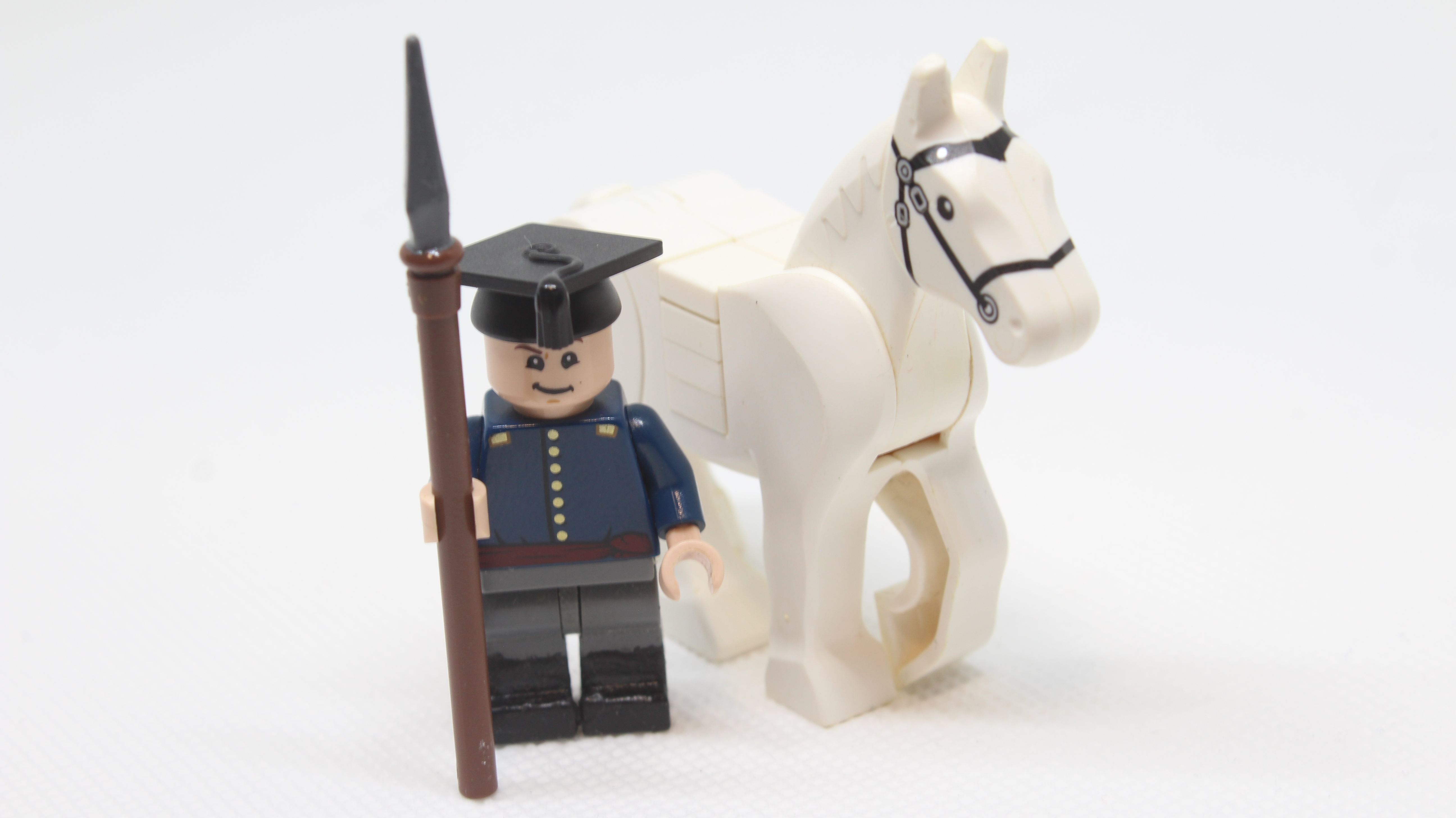
Now that the 104th anniversary of the end of World War 1 comes it is a good opportunity to show you the minifigures I created of the Western Front allied army. You will find here French British and Belgian troops. The first army we will take a look at will be the French one. Most of minifigures here are French as you will see. I love how looks the French uniforms from the XIX century until 1915 when finally useful colors where adopted so soldiers with red pants weren't the easy target they were for modern weapons. The first minifigure is the standard French soldier from 1914. They wore Dark blue coat and kepis with red pants. One of my favourite minifigs I ever did.
All are LEGO parts except the head. It is from Citizen Bricks and the hand-painted Lebel 1886 rifle is from BrickArms. Legs cloth is called "Tuxedo Tails" and can be found here: https://www.capes4minifigs.com/store/index.php?rt=product/product&path=8_30&product_id=86
 |
| Rear view |
 |
| Reference picture. Source: https://guerrayhistoria.wordpress.com/2014/09/26/uniformes-de-la-primera-guerra-mundial-1914-1918/ |
Second minifigure is the one of a Infantry cornet. Surprisingly they were still used by French army at least at the beggining of the war. Couldn't find much information about it but I guess cornets were used to give orders. If you know more about it let me now in the comments box below!
 |
| Same uniform as the standard infantry |
 |
| Reference picture. Source: https://www.pinterest.fr/pin/322077810833674559/ |
Now the Zouave. All Zouaves from armies around the world used almost the same uniform from XIX century until the beggining of WWI. Sometimes you will see them with their typical wide pants in white color too. Same minifig I used before in other videos and scenes. Again thanks to @Yazyas (Instagram) for the amazing torsos he sold me.
 |
| Reference picture. Source: https://commons.wikimedia.org/wiki/File:Zouaves_in_ww1_tournassoud.jpg |
Now time for the officer. Very simple minifig. Again I used the Lone Ranger LEGO torso. Very useful for XIX century armies since dark blue was very spread in the armies worldwide. Cap is from Brickmania. They did an outstanding job with it.
 |
Reference picture for the officer. A general. Source:
https://www.pinterest.fr/pin/693061830133470486/ |
Next one is the French standard soldier from 1915 onwards until the end of the war with their famous horizon blue uniform made so soldiers would be confused with the horizon when they stormed enemy trenches. With this uniform came too the arrival to the frontline of the first steel helmets of the conflict. The famous Adrian Helmet. This one made by BrickArms.
 |
| Cloth is from BrickFabric. You can find their products at https://www.brickssoldier.com/ |
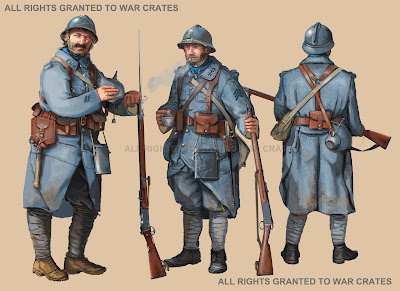 |
| Reference picture. Source: https://manu67.artstation.com/projects/OogdqJ |
Next one is this 1914 NCO from the Chasseurs à Pied. Same uniform as the standard infantry regiments but dark blue pants. Has a saber still carried by NCO and officers at the beggining of the war.
 |
| Hand-painted BrickArms saber |
 |
| Reference picture for Chasseurs à Pied. Source: https://www.bertrand-malvaux.com/fr/p/16068/l-armee-francaise-de-1914-de-aout-a-decembre.html |
Now turn for the Chasseurs Alpins. First the one from 1914.
 |
| Head from Citizen Bricks |
Second Chasseur Alpine is the one from 1916. Beret was replaced for steel helmets. For Adrian helmets.


To finish with the French army we will see the cavalry. First the Dragoons. Cavalry use was very limited and they had to wait all the war for a manouver war that would never come. Some units were used in the trenches as foot infantry. At the beggining of the war they saw few action on mounted actions mainly patrolling when they had a few skirmishes between German and French cavalry units. Later they still used horses to move sometimes for patrols and accompany prisoners but with modern horizon blue uniforms. Helmet is from AliExpress.
 |
| Reference picture. Source: https://www.pinterest.fr/pin/AZEWDozpCxj3ntjqNHkbVPVTsU8ahgsBHBKPTcSO39u0mAI9hSwlZgs/ |
Turn for the Cuirassier. Pretty much the same looks they had for the previous 100 years. Modern warfare wasn't made for them but still there are some curious and cool pictures of them from 1914 and the previous years that led to the war with them wearing their chest protection and beautiful helmets. This is probably my favourite minifig of the ones I ever did. The helmet is a masterpiece and you can easily find it on AliExpress.
 |
Reference picture. Hard to believe this was only a bit more than 100 years ago in 1913.
Source: https://www.reddit.com/r/HistoryPorn/comments/26r0xa/when_might_you_guess_this_picture_was_taken_these/ |
 |
In combat they wore covers over the shining steel of their helmets and chest protections. Source:
https://www.pinterest.fr/pin/322077810833169013/ |
Now is turn for the British Army. Soldiers from other Commonwealth countries could be included but I decided not to since their uniforms were almost the same. Here you will find four British soldiers all of them using the amazing decals from Roaglaan Customs. Sadly his Etsy store is closed but I hope he sells again in the future since the freedom decals give to customize minifigs is massive.
First soldier is the British standard from 1914. Cap is from AliExpress and legs and the BrickArms SMLE and gear are hand-painted by me as always.
 |
| Reference picture. Source: https://www.ebay.es/itm/283449057630 Looks like you can buy it :P |
Next one is the British regular soldier from 1917. Is the same but using the famous British steel helmet.
 |
| Reference picture. Source: https://www.artstation.com/artwork/3dmrlA |
Now let's take a look to the winter version. I used a cloth from AliExpress from a WW2 American soldier. I think it still looks good enough.
 |
| Soldier in the middle is the inspiration for this minifig. Source: https://www.pinterest.fr/pin/439312138654970277/ |
Finally we have a Highlander. There were different units of them and with different skirts colors and designs. Can't say much more since my knowledge of them is very basic. Skirt is from Capes4minifigs.com
 |
| Reference picture. Source: https://www.deviantart.com/timcatherall/art/Highland-soldier-WW1-636039613 |
Final army is the Belgian one. Often forgotten but their effort in the war deserves recognition. Belgium didn't fall completely in German hands since the Belgian army defended succesfully a portion of their land. Let's take a look to the soldiers. First one the standard infantry. Pretty simple minifig.
 |
| Reference picture. Source: https://www.pinterest.co.uk/pin/447123069226351665/ |
Next one is the Carabinier. Pretty cool uniform. Uniforms look kinda outdated for 1914. A very interesting thing from WW1 is how "Napoleonic" some uniforms and units looked like at the beggining of the conflict.
 |
| Reference picture. Belgians used dogs to move MGs. Source: https://www.pinterest.es/pin/131097039137807506/ |
Now the Belgian Grenadier. I guess the bearskin hat wasn't used in combat but who knows. I couldn't find information about them.
 |
| Reference picture. Source: https://www.pinterest.fr/pin/395331673520358151/ |
 |
| Very interesting pictures of machine guns operated by Belgian grenadiers. Source: https://www.reddit.com/r/wwi/comments/2cwhmm/belgian_grenadiers_1914/ |
To start with the cavalry we have now the Belgian Lancier. Very outdated already but other countries still had lanciers after the war.
 |
| Reference picture. Source: http://www.arquebusiers.be/armee-belge-photos-2.htm |
Last one is the Guide. The two historic Guides regiments of the Belgian Army were created respectively in 1833 and 1874. They formed part of the light cavalry and came to correspond to the Guard cavalry of other nations, providing mounted escorts for the monarchy prior to World War I. Both regiments were mechanized in October 1937, subsequently forming armored battalions in the post-war Belgian Army. The mounted tradition survived until 2011 in the form of a pony retained as the regimental mascot, and always named "Colback". (Source: Wikipedia).
 |
| Reference picture. Source: https://www.planetfigure.com/threads/cavalry-guides.76059/ |
Hope you liked it guys! Let me know your opinion and stay tuned for more!